Source:https://www.classicandsportscar.com

You’re standing in a dimly lit garage, the air thick with the scent of aged leather and unburnt hydrocarbons. Before you sits a 1990s Japanese sports car—a vehicle that, ten years ago, you could have picked up for the price of a used hatchback. Today, that same car is hammering down at elite auctions for six figures. While the S&P 500 is the “safe” play, the collector car market has seen certain segments outperform traditional stocks by over 300% in the last decade. But here’s the catch: for every Ferrari that hits a record high, there are a dozen “money pits” waiting to dissolve your savings into a pile of rust and rare parts.

In my twelve years as an automotive consultant and writer, I’ve seen enthusiasts lose their shirts because they bought with their hearts instead of their heads. I’ve also watched savvy collectors turn a passion for “old metal” into a diversified portfolio. The best investments in vintage cars aren’t just about the badge on the hood; they are about scarcity, provenance, and a technical phenomenon I call the “Poster Child Cycle.”

If you’re looking to park your capital in something you can actually drive, this deep-dive will help you navigate the high-octane world of blue-chip automotive assets.


The “Poster Child Cycle”: Why Values Skyrocket

Think of a vintage car like a time-locked savings account. The people who grew up with posters of the Lamborghini Countach or the Nissan Skyline GT-R on their walls are now in their peak earning years. As they look to reclaim their youth, they drive up the demand for the specific models they once idolized.

When searching for the best investments in vintage cars, you aren’t just buying a machine; you’re buying Cultural Equity. We look for cars that hit the “Sweet Spot”: 25 to 35 years old, low production numbers, and a significant impact on automotive history.

The “Matching Numbers” Technicality

One technical detail that separates a “driver” from an “investment” is the concept of Matching Numbers. This means the serial numbers on the engine, transmission, and chassis all match the original factory build records. In the world of high-stakes collecting, a car with a non-original engine can be worth 40% less than a matching-numbers equivalent.


Top Performers: Models Currently Holding (and Gaining) Value

For the beginner or intermediate investor, I’ve categorized the current market leaders into three distinct “Asset Classes.”

1. The “Analog” Supercars (1980s-1990s)

We are currently in the golden age of analog performance. These cars represent the peak of mechanical engagement before driver aids like traction control and paddle shifters took over.

  • The Pick: Porsche 911 (993 Generation). As the last of the air-cooled Porsches, the 993 has a cult following.

  • The Tech: Its air-cooled flat-six engine is simpler to maintain than modern liquid-cooled units, but its scarcity is absolute. They aren’t making any more of them.

  • LSI Keywords: Air-cooled engines, low-mileage survivors, homologation specials.

2. The JDM Legends (Japanese Domestic Market)

The rise of the “Gran Turismo Generation” has turned Japanese performance cars into blue-chip assets.

  • The Pick: Nissan Skyline GT-R (R32 or R34). * My Insight: I’ve watched the R34 GT-R move from a $50,000 car to a $300,000+ asset in record time. The technical reason? The ATTESA E-TS all-wheel-drive system and the RB26DETT engine are over-engineered masterpieces that handle modern power with ease.

3. The “Usable” Classics

These are cars that hold value because they are actually pleasurable to drive on a Sunday morning without breaking down every five miles.

  • The Pick: Mercedes-Benz SL (R107 or R129).

  • The Logic: Mercedes-Benz over-engineered these cars to a ridiculous degree. An R107 SL is like a Swiss watch with wheels; as long as the maintenance is documented, they are incredibly resilient to market crashes.


Evaluating an Investment: The Technical Checklist

When you’re looking at a potential candidate for the best investments in vintage cars, you need to put on your “Mechanical Auditor” hat. Here is the technical data that matters:

  • The Paper Trail (Provenance): A car with a thick binder of service receipts is worth significantly more than a “mystery” car. It proves the Mechanical Integrity over time.

  • The “Original Paint” Premium: Collectors currently value “survivors” (original, unrestored cars) more than perfectly restored ones. A car is only original once; a restoration can be done by anyone with a checkbook.

  • Dry Storage Evidence: Look for “Flash Rust” on the suspension components. If a car has lived in a high-humidity environment, the internal seals in the engine and transmission are likely brittle, leading to expensive “Recommissioning” costs.


Expert Advice: Tips and Hidden Warnings

As someone who has spent a decade under both the hood and the spreadsheets, here is the “Real World” advice you won’t find in a glossy auction catalog.

Tips Pro: The “Manual Gearbox” Multiplier

In the modern world, manuals are dying. In the vintage world, they are king.

  • The Rule: If a model was offered in both automatic and manual (like the BMW M3 or certain Ferraris), the Manual version will almost always be worth 20-50% more. The “engagement” factor is the primary driver of value in the 2020s.

Hidden Warning: The “Restomod” Trap

You’ll see many “Restomods”—classic cars with modern engines and suspensions.

While they are amazing to drive, they are often poor investments. You rarely get back the $150,000 you spent on the custom work. Investors want the “Factory Specification.” Modifying a rare vintage car is like painting a mustache on the Mona Lisa; you might like it, but the market won’t.

The “Maintenance-to-Value” Ratio

  • The Warning: A cheap Ferrari is the most expensive car you will ever own. Before buying, calculate the Annual Carry Cost. If a $50,000 vintage car requires $5,000 a year in specialized maintenance just to stay “fresh,” the car needs to appreciate by 10% annually just for you to break even.


Scannable Investment Filter: Buy or Walk?

Before you pull the trigger on what you think is one of the best investments in vintage cars, run it through this quick filter:

  • [ ] Is it a “Top-Tier” trim? (e.g., an “S” or “Turbo” rather than a base model).

  • [ ] Does it have a clean “Carfax” or equivalent history? (Accident history is an investment killer).

  • [ ] Is the color “Desirable”? (Factory “Hero Colors”—the ones used in brochures—always sell faster).

  • [ ] Are the tires older than 6 years? (Even if they look new, old rubber is a safety hazard and a sign of a “neglected” stationary car).

  • [ ] Does it pass the “Cold Start” test? (Check for smoke or unusual valvetrain noise when the engine is first turned on).


Summary: Drive Your Portfolio

The beauty of the vintage car market is that, unlike a stock certificate, you can take your investment out for a canyon run on a Saturday morning. However, the best investments in vintage cars require a blend of historical knowledge, technical scrutiny, and patience.

Don’t buy a car just because you think it will go up in value. Buy a car that you genuinely love, but use the technical filters above to make sure you aren’t buying a liability. In the end, the best return on investment is the smile you get when the engine fires to life and the road opens up.

Which classic car has always been your “one that got away”? Are you looking for a 90s JDM sleeper or a classic European grand tourer? Share your dream investment in the comments below—I’d love to help you vet it!

You’re twenty miles deep into a trail in the Australian Outback or perhaps the rugged Highlands of Iceland. The “road” has long since dissolved into a chaotic mix of jagged limestone and knee-deep mud. Suddenly, you hear that dreaded clunk-spin-whine—the sound of a shiny, expensive SUV realizing it’s actually just a glorified grocery getter. In the off-road world, there is a brutal honesty: you either have the mechanical soul to conquer the terrain, or you’re just a pedestrian waiting for a very expensive tow truck.

In my twelve years of testing everything from high-speed desert runners to rock-crawling diesels, I’ve learned that the best 4WD off-road trucks aren’t defined by their touchscreens or leather seats. They are defined by their “mechanical sympathy”—the way the gears, lockers, and suspension dance together when the world turns sideways. I’ve spent nights winching out “mall crawlers” and days marveling at stock trucks that defied physics, and it’s taught me that a true off-roader is more than the sum of its parts.

If you’re looking to trade the pavement for the unknown, you need a machine that speaks the language of dirt. This deep-dive is your technical roadmap to the elite performers of 2026.


The Holy Trinity of Off-Road Capability

Think of an off-road truck like a mountain climber. An All-Wheel Drive (AWD) crossover is like someone in expensive sneakers—great for a paved path, but dangerous on a cliff. A true 4WD truck is the climber with spiked boots, harnesses, and an ice axe.

To find the best 4WD off-road trucks, we look for three technical non-negotiables: Ground Clearance, Torque, and Articulation.

The “Locking Differential” Secret

One technical detail beginners often overlook is the Locking Differential (Locker). On a normal road, your wheels need to spin at different speeds to turn corners. Off-road, if one wheel is hanging in the air, a standard “open” diff will send all the power to that spinning air-borne wheel—leaving you stuck. A locker forces both wheels on an axle to turn at the exact same speed, effectively “clawing” you out of the hole.


Top Performers: The Heavy Hitters of 2026

When we evaluate the best 4WD off-road trucks, we categorize them by their “Specialty.” Not every truck is built for every trail.

1. The Toyota Tacoma Trailhunter: The Overlanding King

Toyota has a legendary reputation for reliability, but the Trailhunter trim is a factory-built beast designed for long-term wilderness survival.

  • The Technical Edge: It features Old Man Emu (OME) suspension and a high-mount air intake (snorkel).

  • My Insight: I’ve driven Toyotas through river crossings that would drown a standard truck. The secret isn’t just the height; it’s the waterproofed electrical connectors and breather tubes for the differentials.

  • LSI Keywords: Electronic locking rear differential, approach and departure angles, A-TRAC.

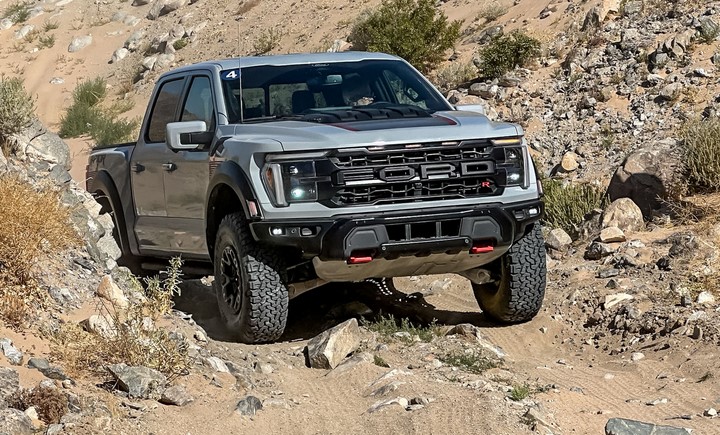
2. The Ford F-150 Raptor: The Desert Flyer

If the Tacoma is a slow-and-steady mountain goat, the Raptor is a trophy truck with a license plate.

  • The Tech: It uses FOX Live Valve shocks that can adjust their damping rates hundreds of times per second based on the terrain.

  • The Experience: Jumping a Raptor at 60 mph feels like landing on a cloud. It is designed for high-speed “Baja” style running where suspension travel (the distance the wheel can move up and down) is the most critical metric.

3. The Jeep Gladiator Rubicon: The Rock Crawler

Jeep is the only manufacturer still offering a Solid Front Axle in a mid-size truck, which is the gold standard for rock crawling.

  • The “Sway Bar Disconnect”: With the push of a button, you can electronically disconnect the sway bar, allowing the front wheels to move independently with massive range.

  • Analogy: It’s like being able to unbutton your pants after a big meal—it gives the truck the flexibility it needs to “wrap” its tires around boulders.


Decoding the Spec Sheet: What Actually Matters?

For intermediate buyers, the marketing fluff can be distracting. When hunting for the best 4WD off-road trucks, look at these specific technical numbers:

  • Approach Angle: The steepest incline a truck can climb without hitting its front bumper.

  • Crawl Ratio: This is a mathematical figure (Transmission x Transfer Case x Differential). A higher number (like 70:1 or 80:1) means the truck can move at a snail’s pace with immense torque—perfect for controlled, slow climbs.

  • Wading Depth: How deep can the truck go before the engine gulps water? In 2026, the best performers are pushing 31 to 35 inches stock.


Expert Advice: Tips and Hidden Warnings

Having spent a decade breaking (and fixing) trucks in the middle of nowhere, here is the “real-world” advice you won’t get from a salesman.

Tips Pro: Tires are 80% of the Battle

You can have the most advanced 4WD system in the world, but if you’re running street tires, you’re going nowhere.

  • The Upgrade: Switch to All-Terrain (A/T) or Mud-Terrain (M/T) tires immediately.

  • The Secret: Learn to “Air Down.” Dropping your tire pressure from 35 psi to 15 psi doubles the size of your “footprint,” giving you massive traction on sand and rocks. Just remember to air back up before hitting the highway!

Hidden Warning: The “Payload” Trap

Off-road trucks often have lower payload capacities than their “work” counterparts.

  • Why? Soft, long-travel suspension (great for rocks) is terrible for hauling heavy loads. If you bolt on a heavy steel bumper, a winch, a roof-top tent, and a fridge, you might actually exceed your truck’s Gross Vehicle Weight Rating (GVWR), making it dangerous to drive and prone to snapping an axle.

“Independent Front Suspension” (IFS) Boots

Most modern trucks use IFS for better highway comfort.

  • The Risk: The CV (Constant Velocity) boots are made of rubber. One sharp stick or a jagged rock can tear that boot, letting grease out and dirt in. Once that happens, your CV joint will fail within miles. I always carry heavy-duty zip ties and “trail boots” (emergency wraps) in my recovery kit.


Scannable Checklist: Is It Trail-Ready?

Before you sign that finance agreement for one of the best 4WD off-road trucks, ensure it meets these “Expert Standards”:

  • [ ] Underbody Protection: Does it have steel skid plates protecting the oil pan and transfer case?

  • [ ] Recovery Points: Are there frame-mounted tow hooks on both the front and rear? (Hint: The “tie-down” loops used for shipping are NOT recovery points).

  • [ ] Transfer Case: Does it have a “4-Low” gear set? If it only has “4-High” or “Auto AWD,” it’s not a true off-roader.

  • [ ] Tire Clearance: Can it fit a 33-inch or 35-inch tire without a massive, expensive lift kit?


Summary: The Dirt Path to Freedom

The best 4WD off-road trucks of 2026 are marvels of engineering, bridging the gap between civilized daily driving and raw, unadulterated adventure. Whether you choose the surgical precision of a Jeep, the indestructible spirit of a Toyota, or the raw power of a Ford, remember that the truck is only the tool. The real adventure is the one you have when the cell service bars drop to zero.

Invest in the right hardware, learn your technical limits, and never—ever—go off-roading alone without a recovery strap and a plan.

What’s your “Dream Trail” destination? Are you a high-speed desert runner or a slow-and-steady rock crawler? Share your favorite rig in the comments below—I’d love to talk tech with you!

Source:https://tatumatkinson.com

You’re cruising at 60 mph, the radio is playing your favorite track, and for a split second, you glance down to check a notification on your phone. In that heartbeat—roughly 4.6 seconds—you’ve just traveled the length of a football field blindfolded. Statistically, over 90% of road collisions are caused by human error, and most of them happen within 25 miles of home. The road isn’t just a stretch of asphalt; it’s a high-stakes environment where the laws of physics are always enforced, and there are no “undo” buttons.

In my decade of testing performance vehicles and analyzing telematics data, I’ve realized that the most important safety feature isn’t the 12 airbags or the Automatic Emergency Braking (AEB) in your car—it’s the six inches of space between your ears. I’ve sat in the passenger seat with professional racing drivers and terrified teenagers, and the difference between a survivor and a statistic often comes down to defensive driving.

If you want to master the best ways to avoid car accidents, you need to stop driving “reactively” and start driving “proactively.” This guide is your technical and psychological roadmap to staying safe on the grid.


The Philosophy of the “Bubble”: Defensive Driving 101

Think of your car as a moving magnet. Every other object on the road—the erratic delivery van, the speeding motorcycle, the distracted pedestrian—is a North Pole trying to push against your North Pole. Your goal is to maintain a “Safety Bubble” that prevents these magnets from ever touching.

When we talk about defensive driving, we are talking about Spatial Awareness and Kinetic Energy Management. If you can control the space around your vehicle, you control the outcome of almost any situation.

The 3-Second Rule and Perception-Reaction Time

Technically, the “3-Second Rule” is based on Perception-Reaction Time (PRT). It takes the average human about 1.5 seconds to realize there’s a hazard and another 1.5 seconds to physically apply the brakes. At highway speeds, that 3-second gap is the bare minimum required to dissipate the kinetic energy of a 4,000-lb metal box.


Scanning the Horizon: Beyond the Hood Ornament

One of the biggest mistakes beginners make is “tunnel vision”—staring at the bumper of the car directly in front of them. To truly find the best ways to avoid car accidents, you need to scan at least 12 to 15 seconds ahead.

  • The 15-Second Lead: This allows you to see traffic lights changing three blocks away or brake lights flickering five cars ahead.

  • The “Look Through” Technique: I always teach my students to look through the windows of the car in front of them. If you see the brake lights of the third car ahead, you can start slowing down before the guy directly in front of you even realizes there’s a problem.

  • LSI Keywords: Predictive driving, traffic flow analysis, collision avoidance systems.


Managing Intersections: The Danger Zone

Intersections are the most complex “puzzle pieces” on the road. Roughly 40% of all accidents occur at intersections. Even if you have a green light, you are not “safe.”

The “Clearing the Intersection” Ritual

I never enter an intersection the moment the light turns green. I wait two seconds and look Left, Right, and Left again. * Why? “Red-light runners” are most likely to hit you in those first three seconds of a light change.

  • The Technical Edge: By looking left first, you are checking the lane closest to you—the one where a collision would be most immediate and severe.


Vehicle Dynamics: Understanding Your Machine

You can be the best driver in the world, but if your hardware fails, the software (you) won’t matter. Defensive driving includes Pre-Trip Technical Audits.

  • Tire Contact Patches: Your car stays on the road via four patches of rubber, each about the size of a smartphone. If your tread depth is below 2/32 of an inch, or if your tire pressure is incorrect, your braking distance increases exponentially, especially in wet conditions.

  • Weight Transfer: When you slam on the brakes, the weight of the car shifts to the front tires (Nose-dive). If you are mid-turn when this happens, you risk Oversteer (the rear sliding out). Smooth inputs are the key to maintaining traction.


Expert Advice: Tips and Hidden Warnings

As an automotive writer who has spent thousands of hours analyzing crash data, here is the “real talk” you won’t find in a standard driver’s ed manual.

Tips Pro: The “Exit Strategy”

Always leave yourself an “out.” When you stop behind another car at a light, you should be able to see their rear tires touching the pavement. * The Reason: If a car behind you looks like it won’t stop in time, or if the car in front stalls, you have enough steering angle to pull out and escape without having to reverse.

Hidden Warning: The “Blind Spot” Mirage

Modern cars have Blind Spot Monitoring (BSM), but they aren’t foolproof. Sensors can fail, and fast-moving motorcycles can enter your blind spot between the sensor’s “sweeps.”

  • The Expert Fix: Adjust your side mirrors outward until you can no longer see the side of your own car. This overlaps the view between your rearview and side mirrors, virtually eliminating the blind spot. If you can see your own car in the side mirrors, they are pointed too far inward.

“Velocitation”

After a long stint on the highway, your brain gets used to high speeds—a phenomenon called Velocitation. When you exit into a 30-mph zone, it feels like you’re crawling, causing you to inadvertently speed. Always check your speedometer when exiting a highway; don’t trust your “feel.”


Defensive Driving in Adverse Conditions

The best ways to avoid car accidents change when the environment turns hostile. Whether it’s heavy rain in Central Java or black ice in the mountains, the physics remain the same: Lower Friction = Lower Control.

  • Hydroplaning: This happens when a layer of water builds up between your tires and the road. If you feel the steering go “light,” do not slam the brakes. Ease off the accelerator and keep the wheel straight until you feel the tires “bite” the asphalt again.

  • Night Driving: Your high beams only reach about 350-500 feet. At 60 mph, you are “overdriving your headlights,” meaning you can’t stop within the distance you can see. Slow down by at least 5-10 mph at night to compensate for reduced depth perception.


Scannable Checklist for Every Drive

Before you put the car in gear, run through this quick mental check to ensure you’re practicing the best ways to avoid car accidents:

  • [ ] Phone on “Do Not Disturb”: Eliminating the #1 source of distraction.

  • [ ] Mirror Check: Can I see my own car? (If yes, move them out!).

  • [ ] The 4-Second Gap: Is it raining? Increase your following distance to 4 or 5 seconds.

  • [ ] Lights On: Even in daylight, keeping your headlights on increases your visibility to others by up to 25%.

  • [ ] Tire Health: Do I have enough tread for the weather?


Summary: Control the Controllables

Driving is the most dangerous thing most of us do every single day. But by adopting a defensive mindset, you move from being a “target” to being a “pilot.” You cannot control the person texting in the next lane, but you can control your distance from them, your speed, and your readiness to react.

The best ways to avoid car accidents aren’t found in a fancy gadget; they are found in your commitment to being present every time you get behind the wheel. Drive like everyone else on the road is trying to hit you, and you’ll likely never give them the chance.

What was the closest call you’ve ever had on the road, and what did it teach you about your driving habits? Or maybe you have a “secret” safety tip that saved you once? Let’s talk safety in the comments below!