 You’re twenty miles deep into a trail in the Australian Outback or perhaps the rugged Highlands of Iceland. The “road” has long since dissolved into a chaotic mix of jagged limestone and knee-deep mud. Suddenly, you hear that dreaded clunk-spin-whine—the sound of a shiny, expensive SUV realizing it’s actually just a glorified grocery getter. In the off-road world, there is a brutal honesty: you either have the mechanical soul to conquer the terrain, or you’re just a pedestrian waiting for a very expensive tow truck.
In my twelve years of testing everything from high-speed desert runners to rock-crawling diesels, I’ve learned that the best 4WD off-road trucks aren’t defined by their touchscreens or leather seats. They are defined by their “mechanical sympathy”—the way the gears, lockers, and suspension dance together when the world turns sideways. I’ve spent nights winching out “mall crawlers” and days marveling at stock trucks that defied physics, and it’s taught me that a true off-roader is more than the sum of its parts.
If you’re looking to trade the pavement for the unknown, you need a machine that speaks the language of dirt. This deep-dive is your technical roadmap to the elite performers of 2026.
The Holy Trinity of Off-Road Capability
Think of an off-road truck like a mountain climber. An All-Wheel Drive (AWD) crossover is like someone in expensive sneakers—great for a paved path, but dangerous on a cliff. A true 4WD truck is the climber with spiked boots, harnesses, and an ice axe.
To find the best 4WD off-road trucks, we look for three technical non-negotiables: Ground Clearance, Torque, and Articulation.
The “Locking Differential” Secret
One technical detail beginners often overlook is the Locking Differential (Locker). On a normal road, your wheels need to spin at different speeds to turn corners. Off-road, if one wheel is hanging in the air, a standard “open” diff will send all the power to that spinning air-borne wheel—leaving you stuck. A locker forces both wheels on an axle to turn at the exact same speed, effectively “clawing” you out of the hole.
Top Performers: The Heavy Hitters of 2026
When we evaluate the best 4WD off-road trucks, we categorize them by their “Specialty.” Not every truck is built for every trail.
1. The Toyota Tacoma Trailhunter: The Overlanding King
Toyota has a legendary reputation for reliability, but the Trailhunter trim is a factory-built beast designed for long-term wilderness survival.
-
The Technical Edge: It features Old Man Emu (OME) suspension and a high-mount air intake (snorkel).
-
My Insight: I’ve driven Toyotas through river crossings that would drown a standard truck. The secret isn’t just the height; it’s the waterproofed electrical connectors and breather tubes for the differentials.
-
LSI Keywords: Electronic locking rear differential, approach and departure angles, A-TRAC.
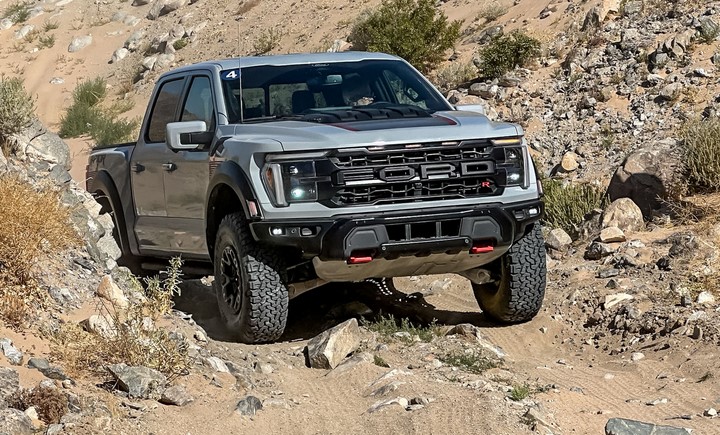
2. The Ford F-150 Raptor: The Desert Flyer
If the Tacoma is a slow-and-steady mountain goat, the Raptor is a trophy truck with a license plate.
-
The Tech: It uses FOX Live Valve shocks that can adjust their damping rates hundreds of times per second based on the terrain.
-
The Experience: Jumping a Raptor at 60 mph feels like landing on a cloud. It is designed for high-speed “Baja” style running where suspension travel (the distance the wheel can move up and down) is the most critical metric.
3. The Jeep Gladiator Rubicon: The Rock Crawler
Jeep is the only manufacturer still offering a Solid Front Axle in a mid-size truck, which is the gold standard for rock crawling.
-
The “Sway Bar Disconnect”: With the push of a button, you can electronically disconnect the sway bar, allowing the front wheels to move independently with massive range.
-
Analogy: It’s like being able to unbutton your pants after a big meal—it gives the truck the flexibility it needs to “wrap” its tires around boulders.
Decoding the Spec Sheet: What Actually Matters?
For intermediate buyers, the marketing fluff can be distracting. When hunting for the best 4WD off-road trucks, look at these specific technical numbers:
-
Approach Angle: The steepest incline a truck can climb without hitting its front bumper.
-
Crawl Ratio: This is a mathematical figure (Transmission x Transfer Case x Differential). A higher number (like 70:1 or 80:1) means the truck can move at a snail’s pace with immense torque—perfect for controlled, slow climbs.
-
Wading Depth: How deep can the truck go before the engine gulps water? In 2026, the best performers are pushing 31 to 35 inches stock.
Expert Advice: Tips and Hidden Warnings
Having spent a decade breaking (and fixing) trucks in the middle of nowhere, here is the “real-world” advice you won’t get from a salesman.
Tips Pro: Tires are 80% of the Battle
You can have the most advanced 4WD system in the world, but if you’re running street tires, you’re going nowhere.
-
The Upgrade: Switch to All-Terrain (A/T) or Mud-Terrain (M/T) tires immediately.
-
The Secret: Learn to “Air Down.” Dropping your tire pressure from 35 psi to 15 psi doubles the size of your “footprint,” giving you massive traction on sand and rocks. Just remember to air back up before hitting the highway!
Hidden Warning: The “Payload” Trap
Off-road trucks often have lower payload capacities than their “work” counterparts.
-
Why? Soft, long-travel suspension (great for rocks) is terrible for hauling heavy loads. If you bolt on a heavy steel bumper, a winch, a roof-top tent, and a fridge, you might actually exceed your truck’s Gross Vehicle Weight Rating (GVWR), making it dangerous to drive and prone to snapping an axle.
“Independent Front Suspension” (IFS) Boots
Most modern trucks use IFS for better highway comfort.
-
The Risk: The CV (Constant Velocity) boots are made of rubber. One sharp stick or a jagged rock can tear that boot, letting grease out and dirt in. Once that happens, your CV joint will fail within miles. I always carry heavy-duty zip ties and “trail boots” (emergency wraps) in my recovery kit.
Scannable Checklist: Is It Trail-Ready?
Before you sign that finance agreement for one of the best 4WD off-road trucks, ensure it meets these “Expert Standards”:
-
[ ] Underbody Protection: Does it have steel skid plates protecting the oil pan and transfer case?
-
[ ] Recovery Points: Are there frame-mounted tow hooks on both the front and rear? (Hint: The “tie-down” loops used for shipping are NOT recovery points).
-
[ ] Transfer Case: Does it have a “4-Low” gear set? If it only has “4-High” or “Auto AWD,” it’s not a true off-roader.
-
[ ] Tire Clearance: Can it fit a 33-inch or 35-inch tire without a massive, expensive lift kit?
Summary: The Dirt Path to Freedom
The best 4WD off-road trucks of 2026 are marvels of engineering, bridging the gap between civilized daily driving and raw, unadulterated adventure. Whether you choose the surgical precision of a Jeep, the indestructible spirit of a Toyota, or the raw power of a Ford, remember that the truck is only the tool. The real adventure is the one you have when the cell service bars drop to zero.
Invest in the right hardware, learn your technical limits, and never—ever—go off-roading alone without a recovery strap and a plan.
What’s your “Dream Trail” destination? Are you a high-speed desert runner or a slow-and-steady rock crawler? Share your favorite rig in the comments below—I’d love to talk tech with you!