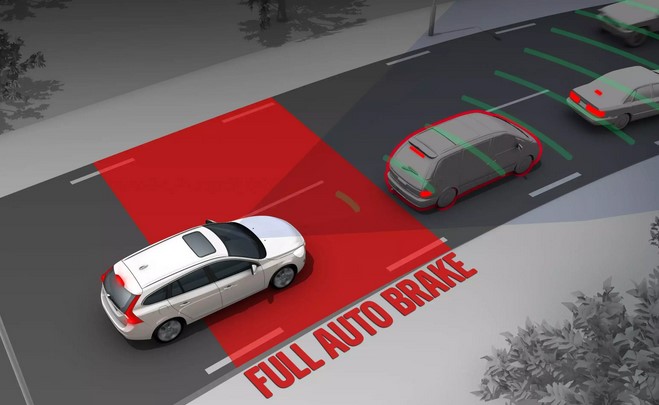
 You are driving home after a grueling ten-hour workday. Your mind is wandering, calculating tomorrow’s to-do list, when the brake lights of the SUV ahead suddenly flare a bright, angry red. In the fraction of a second it takes your brain to register the danger and your foot to reach the pedal, an invisible force slams the brakes for you. Your seatbelt locks, the ABS chatters, and your car screeches to a halt just inches from a crumpled bumper.
During my decade inside automotive test facilities and repair bays, I have witnessed countless crumpled hoods caused by a single second of driver distraction. The statistics are staggering: front-to-rear crashes account for nearly a third of all police-reported accidents. Yet, vehicles equipped with advanced automatic emergency braking (AEB) reduce these rear-end collisions by roughly 50%. This technology is no longer a premium luxury gimmick; it is a critical co-pilot that bridges the gap between human error and physical reality.
If you are looking to buy a new vehicle or trying to understand the active safety features already built into your current ride, understanding how AEB operates can entirely change how you view road safety.
Demystifying the Brains Behind the Brakes: How AEB Works
To understand automatic emergency braking, think of it as a vigilant digital lookout paired with a hyper-reactive muscle. Instead of relying on a human eye, which can blink, look away, or get blinded by glare, the vehicle uses a network of high-tech hardware to map the world ahead.
Most modern setups rely on sensor fusion, a technical approach where different types of hardware work together to double-check each other’s data:
-
Forward-Facing Cameras: Mounted high up near your rearview mirror, these cameras actively analyze the shapes, lane markings, and brake lights ahead.
-
Radar Sensors: Hidden behind the front grille or bumper emblem, radar units emit radio waves that bounce off solid objects to calculate exact distances and closing speeds, regardless of heavy rain, fog, or darkness.
-
LiDAR (Light Detection and Ranging): Emerging on cutting-edge systems, these sensors use laser beams to create highly precise 3D maps of the surroundings.
To make sense of this difficult concept, imagine trying to catch a baseball in the dark. Your eyes (the camera) might struggle to track the ball’s shape, but your ears (the radar) can hear it whistling through the air. By combining both senses, your brain accurately calculates exactly when to put your mitt up.
When your car’s central computer detects a rapidly closing gap with an obstacle, it executes a strict, multi-stage defense protocol:
-
Forward Collision Warning (FCW): The system flashes red dashboard lights and sounds an aggressive beep to command your attention.
-
Brake Support / Dynamic Brake Support: If you tap the brakes but do not press hard enough, the system automatically maximizes hydraulic brake pressure.
-
Autonomous Intervention: If you fail to react entirely, the car takes over, clamping the brake calipers onto the rotors to stop the vehicle or significantly mitigate the force of an unavoidable impact.
The Best Automatic Emergency Braking Systems on the Road
While the underlying concept is universal, individual automotive manufacturers tune their software and choose their hardware packages differently. Based on rigorous testing data from the Insurance Institute for Highway Safety (IIHS) and real-world performance, these manufacturers offer the most dependable AEB systems.
1. The Benchmark for Precision: Subaru EyeSight®
Subaru took a unique path by utilizing a dual-camera system mounted inside the windshield, mimicking human stereoscopic vision.
Because it processes depth perception much like our own eyes, Subaru’s Pre-Collision Braking system is exceptionally good at identifying unconventional road hazards, such as cyclists, pedestrians, and errant shopping carts. The latest iterations feature an expanded field of view that can detect hazards at complex intersections.
-
Pros: Exceptional depth perception; handles pedestrian and cyclist detection brilliantly; less prone to radar-based false positives from metal guardrails.
-
Cons: Heavy interior windshield fog or torrential downpours can temporarily block the cameras’ line of sight.
2. High-Speed Reliability: Toyota Safety Sense (TSS 3.0)
Toyota has democratized active safety by making its robust TSS suite standard equipment across almost its entire lineup, from the affordable Corolla to the rugged Tacoma.
The system utilizes a refined combo of long-range radar and a single-lens camera. TSS 3.0 excels at high-speed highway detection, providing seamless deceleration without making the driver panic. It also features Junction Turning Assist, which prevents you from making a dangerous left turn into oncoming traffic.
-
Pros: Highly consistent highway performance; standard equipment across almost all trims; excellent radar performance in poor visibility.
-
Cons: Can occasionally feel overly cautious, triggering acoustic warnings early in tight urban environments.
3. The Gold Standard for Premium Protection: Volvo City Safety
Volvo pioneered autonomous braking technology, and its modern setups remain incredibly sophisticated.
Using a blend of radar and high-resolution cameras, City Safety operates effectively at all speeds, both day and night. It is uniquely programmed to detect large animals—like deer or moose—and can actively assist with evasive steering if braking alone cannot prevent a collision.
-
Pros: World-class night-vision capabilities; large animal detection parameters; smooth, progressive brake application.
-
Cons: Often restricted to luxury price points; repairs to the sensor modules after a minor bumper scrape can be expensive.
Essential Tech Vocabulary: Navigating the Jargon
When exploring vehicle window stickers or browsing digital brochures, you will encounter various acronyms. Here is what they actually mean:
-
ADAS (Advanced Driver Assistance Systems): The umbrella term for all electronic safety aids, including lane-keeping assist, adaptive cruise control, and AEB.
-
Pedestrian Detection: An advanced software capability that differentiates the moving limbs of a human from static road objects.
-
False Positive: A situation where the AEB mistakenly identifies an innocuous object—like a low-hanging tree branch or a reflective road sign—as a hazard and stabs the brakes unnecessarily.
-
Rear Cross-Traffic Braking: An extension of AEB that monitors your blind spots when reversing out of parking spaces and applies the brakes if an oncoming vehicle crosses your path.
Expert Advice: The Invisible Limitations of Your System
Pro Tip: The Windshield Maintenance Rule
Many drivers do not realize that their car’s active safety features are highly dependent on the condition of their glass. If your car uses a camera-based system mounted behind the rearview mirror, a layer of road salt, heavy dirt, or a star-shaped rock chip directly in front of that lens can completely blind your AEB system.
Furthermore, if you ever need to replace your windshield due to a crack, you cannot just drive away once the glass is glued in. The camera module must be professionally recalibrated by a technician using specialized targets. Skipping this calibration can cause your AEB system to miscalculate distances by several crucial feet.
Finding Your Comfort Zone With Safety Tech
As vehicles march toward an increasingly automated future, automatic emergency braking stands out as one of the greatest mechanical innovations of the modern era. It does not replace the responsibilities of an attentive driver, but it acts as a flawless safety net for those split-second moments when human attention falters.
When cross-shopping your next vehicle, look beyond the leather seats and infotainment screens. Ask the dealer for a deep dive into the active safety suite, check the vehicle’s crash mitigation ratings on the IIHS database, and prioritize systems that offer comprehensive pedestrian and intersection protection.
Have you ever had an automatic emergency braking system step in and save you from a fender bender? Do you prefer a system that gives you early warnings, or one that only intervenes at the absolute last second? Let me know your experiences or ask your questions in the comments below!